
She searches for ten minutes. Keyword queries return nothing useful, even though the archive should stay searchable fast enough that retrieval speed does not fall apart as team libraries grow beyond 100k files. Folders are labeled by date, by camera operator, by some system that made sense three years ago to someone who no longer works there. So she opens a new project and starts recording from scratch. Not because she is undisciplined. Because your retrieval system made starting over faster than searching.
This is the recreation tax. And it is one of the most underreported productivity drains in regional media today.

The Recreation Tax: Why Search Slows Down as Archives Grow Beyond 100k Files
The recreation tax is not a storage problem. Storage is cheap. The problem is retrieval — specifically what happens when editors, producers, and journalists stop trusting that a search will return what they need before their deadline expires.
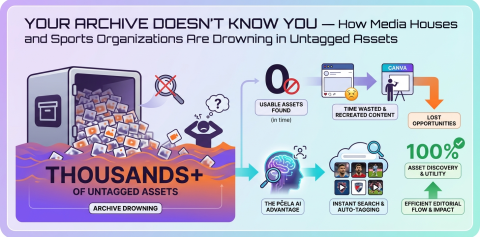
Consider a sports broadcaster with fifteen years of match footage. Material that sponsors would pay to license, that editors could repurpose for anniversary packages. But because metadata was never consistently applied, the archive is effectively dark. Assets exist. They are just unfindable.
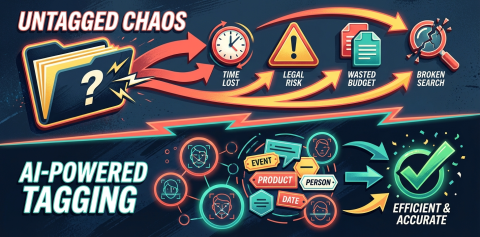
The business cost accumulates quietly. Editorial hours spent recreating content. Licensing fees paid for stock footage the organization already owns. Missed revenue from archival footage that never reaches rights buyers. Keyword-reliant systems degrade as libraries grow, especially once team libraries pass 100k files and editors can no longer trust search to return the right clip in time. That is why search speed at scale has become the real test of any platform. Editors learn this quickly and adjust their behavior accordingly. The recreation tax compounds every day the system stays broken.
What the Industry Data Actually Tells Regional Media Houses
The digital asset management market is not a niche concern for media companies managing large video libraries. Growth is not driven by organizations buying more storage. It is driven by organizations finally treating their assets as something worth retrieving.
The performance gap is measurable. AI-powered DAM saves marketing teams an average of 11 to 18 hours per week. Teams using integrated DAM solutions find assets 60% faster and publish campaigns 40% faster. And 35% of marketing teams using DAM report getting to market faster — a figure that reflects not just speed but the compounding advantage of not recreating what you already own.
Video management is the defining shift of this cycle. In 2026, 83% of organizations manage video in their DAM, up from 68% in 2025. Organizations without video-capable retrieval are falling behind on the category that matters most.
For regional media houses in the Balkans and wider Central and Eastern Europe, the gap is structural. Most are still operating on generic cloud storage with folder-based organization — systems built for documents, never designed for broadcast-quality video at newsroom volume.
97% of companies report that AI-driven trends have fundamentally reshaped their content operations. This is not a coming shift; it has already happened in digital asset management for media companies that depend on fast retrieval at newsroom scale.
Why Generic DAMs Fail When Libraries Grow Beyond 100k Files
As libraries grow beyond tens of thousands of assets, keyword-reliant search returns progressively noisier results. Users report that search "used to work" but no longer does. Bynder and Canto users specifically report search degradation and performance issues in large libraries. This is not a bug in any specific product — it is a structural limit of systems that depend on human tagging discipline to function at scale.
Human tagging discipline does not scale. It never has.
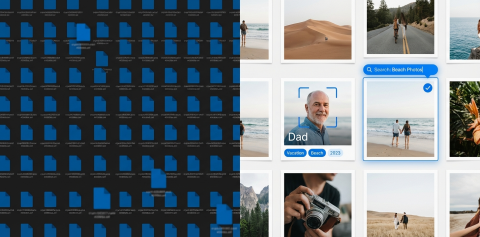
AI-first indexing changes the dependency. Instead of requiring consistent manual metadata, semantic search builds meaning from content itself — from visual features, from spoken words, from contextual relationships between assets. The library can grow without retrieval degrading.
Pčela is built on this model. Rather than treating metadata as a prerequisite for search, Pčela uses semantic indexing and face recognition to maintain retrieval accuracy even when manual tagging is incomplete or entirely absent. An archive of thousands of news clips becomes searchable by the faces that appear in them, by the topics discussed, by visual content that was never described in a filename.
Most legacy DAMs treat a video file as an opaque object. The spoken content inside — the press conference, the interview, the live report — remains invisible to search. LitteraWorks integration in Pčela solves this directly. When a video is ingested, LitteraWorks automatically transcribes the audio, making every spoken word searchable.
For newsrooms running operations in regional languages — Serbian, Croatian, Bosnian, Bulgarian — this matters more than it does for English-language operations, because global platforms have not prioritized regional language accuracy in their speech models.
GDPR, Data Residency, and the Compliance Imperative
GDPR compliance is not a checkbox. For EU-funded projects, public broadcasters, and civic-tech organizations, it is a procurement filter that eliminates entire categories of platforms before evaluation begins.
The specific concern is data residency. Footage containing identifiable individuals — news coverage, sports events, protest footage — carries legal exposure determined in part by where that footage is physically stored and processed. If the server is in Virginia, the GDPR analysis is different than if it is in Frankfurt.
Pčela is EU-hosted on Hetzner in Germany — GDPR compliant. This is not a marketing claim. It is an architectural fact: assets, metadata, face recognition data, and transcription outputs are processed and stored on EU soil, under German data protection law. For a regional broadcaster evaluating DAM options, or an NGO working with EU grant funding, this resolves the data residency question without requiring legal workarounds.
The NEWLOCAL shared tech stack project — which piloted shared infrastructure for small regional newsrooms — reported a 41% average increase in session length after implementation. Compliance and performance are not in tension when the architecture is designed correctly from the start.
From Fragmented Archives to Revenue-Ready Asset Systems
Here is what a modern AI-first DAM workflow actually looks like in practice.
A video file is ingested into Pčela. LitteraWorks automatically transcribes the audio, generating a searchable text record of everything spoken in the clip. Face recognition identifies known individuals, applying auto-tagging without manual input. The asset is immediately searchable from within mPanel CMS without requiring the journalist to switch platforms or re-enter any information. From ingestion to searchability, the process is automated.
This is what AI-first DAM means in practice. Not a better folder structure. A system where content itself generates its own findability — and where that findability holds as the library grows over years of operation.
The criteria that matter for regional media houses evaluating platforms are: does search stay accurate at scale, can video content be retrieved by what is said in it, does the platform support regional languages at production quality, is the hosting GDPR-compliant, and does the system integrate with the CMS editors already use. Pčela was built against exactly this criteria set.
One honest caveat: AI-first systems require an onboarding period. Face recognition needs a base of labeled individuals to recognize. Semantic models improve with use. The short-term friction is real. But the alternative is a keyword search that works on a small library and degrades into uselessness as that library grows — which is exactly the trajectory that produces the recreation tax in the first place.
The question for digital asset management for media companies in 2026 is not whether to adopt AI-first indexing. It is whether to adopt AI-first DAM 2026 workflows before or after your editors have spent another year recreating content your archive already contains.
If your editorial team is spending time recreating content that already exists in your archive, the problem is retrieval. It will not fix itself. Book a demo with the Pčela team to see AI-first indexing, face recognition, and GDPR-compliant asset management working in a workflow built for regional media.