![The Hidden Cost of Untagged Media Archives [Infographic]](https://appworks.mpanel.app/image/cache/original/files/images/content-visual-1775511918839.png)
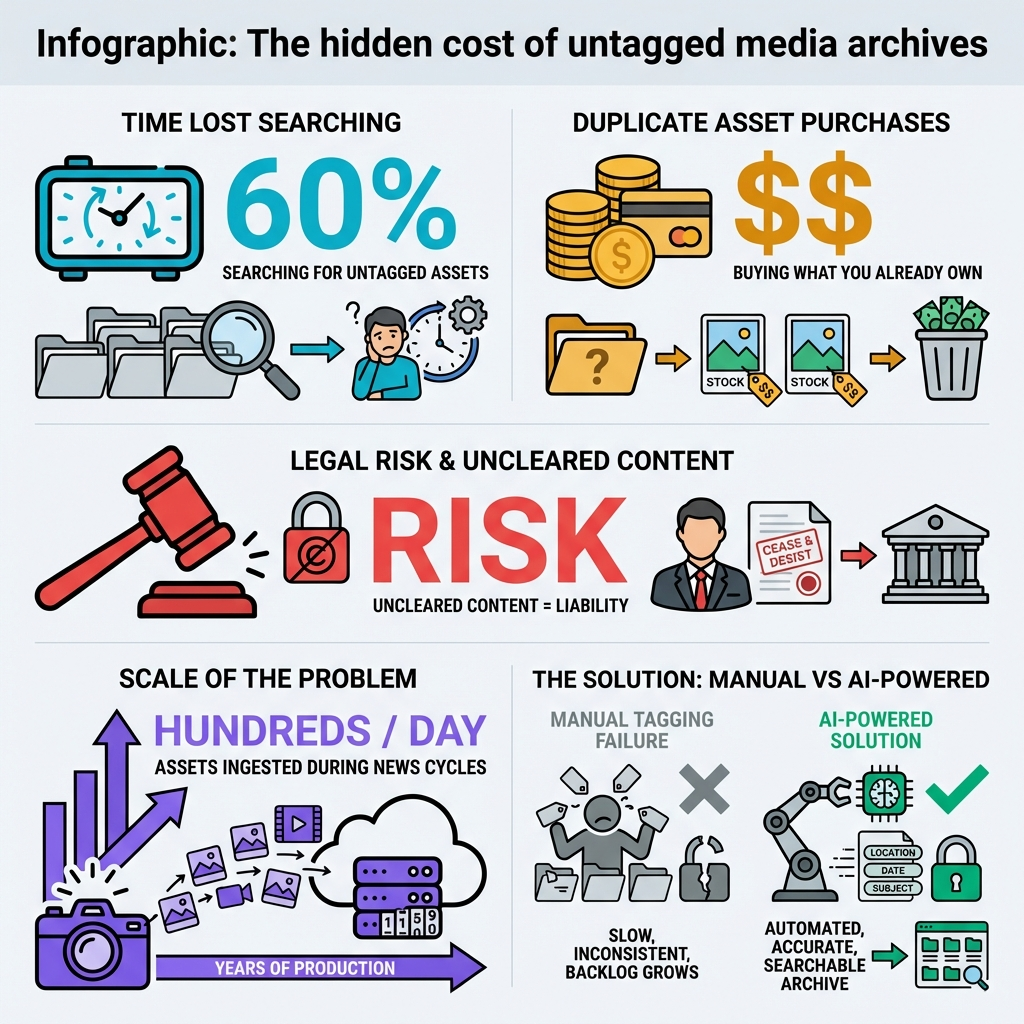
Picture a photo desk on a breaking news day. The team shoots and ingests hundreds of assets before deadline. By Friday, those files sit in the system: unlabeled, unsearchable, and for all practical purposes, gone. Multiply that across every major news cycle over years of active production. The cost of untagged media archives isn't a future problem. It's accumulating right now, on servers your team pays to maintain but increasingly cannot use.
How Fast Does an Untagged Archive Actually Grow?
A single photo desk during a major news cycle can produce hundreds of assets per day. Each file that enters the system without a tag, a subject label, or a face annotation is an asset the search index cannot find, the licensing team cannot audit, and the archive effectively cannot use.
The problem isn't historical. It's happening today, with every upload that skips the metadata step.
Responsible ingest-time tagging doesn't mean a junior staffer manually entering keywords at 11 PM. It means the system does the work at the moment of ingest, before the file ever reaches the archive. Tools like Pčela are built specifically for this environment: high-volume editorial pipelines where the window between capture and publication is measured in minutes, not hours.
The Time Tax: What Untagged Assets Cost Your Team Every Day
Search time is the tax nobody budgets for. When assets lack metadata, editors don't find files faster with a better query. They just search longer. That time doesn't get absorbed quietly — it displaces actual editorial work.
The cost doesn't show up as a line item. It shows up as slower turnaround, missed reuse opportunities, and duplicate licensing fees paid for assets the team already owns but couldn't find. And it peaks at exactly the wrong moment: when a story breaks and deadline pressure is highest.
Why "We'll Tag It Later" Always Fails
Retrospective tagging projects in active newsrooms have a near-zero completion rate. Not because teams lack the will — because the production pipeline never slows enough to create the runway for catch-up work.
By the time a tagging sprint is halfway through last month's archive, this month's archive has already grown by the same volume. Manual catch-up is structurally incapable of clearing a backlog that grows faster than human throughput can address.
The cycle breaks when tagging moves upstream. Not when the team gets bigger.
The Legal Risk Nobody Budgets For
Using an asset with an expired license is not a historical error. It's an active exposure. Untagged archives make this invisible — if a face isn't identified, it can't be flagged for clearance. If a license expiry isn't attached to the asset record, no automated check can catch it before publication.
For EU-based and publicly funded organizations, this has an enforceable dimension. GDPR obligations around identifiable individuals in archived imagery require organizations to demonstrate they know what personal data they hold and whether consent applies. An untagged archive full of recognizable faces is precisely the kind of data governance gap regulators are equipped to act on.
This is why Pčela is EU-hosted and GDPR-compliant by design. The AI face recognition processing doesn't create a secondary compliance problem while solving the first one. For public broadcasters and EU-funded media organizations, that distinction isn't a nice-to-have. It's a procurement requirement.
The Only Fix That Scales: AI Tagging at Ingest
Tag at ingest, not after the damage compounds. Every asset that enters the archive with metadata attached is searchable, licensable, auditable, and usable. Every asset that enters without it is a liability that grows more expensive over time.
But throughput alone doesn't solve the problem. Most AI tagging pilots stall not because of the AI — but because of integration. A tagging system that requires a separate workflow or a manual export step doesn't get used consistently. It gets used for a few weeks, then quietly abandoned when deadline pressure returns.
Pčela, developed by AppWorks, integrates directly with mPanel CMS. There's no parallel workflow, no export-import loop, no moment where the tagger and the publisher operate in separate systems. The tagging happens where the assets live. And because Pčela is EU-hosted and GDPR-compliant, it satisfies the legal risk vector and the operational one simultaneously.
The untagged media archive cost is real, it's compounding, and manual processes cannot reverse it. The only operationally viable answer is to stop the accumulation at the source.
See how Pčela integrates with your existing CMS. Contact the AppWorks team to request a demo for your editorial team.