

The stakes are higher than most teams realize. Publishers who treat audio as a feature bolt-on will waste resources, frustrate editorial teams, and miss the strategic opportunity to capture new revenue while meeting regulatory requirements. Meanwhile, competitors who approach audio publishing strategically are already capturing audience habits and building sustainable multi-format operations.
The Strategic Case for Audio: Beyond Accessibility
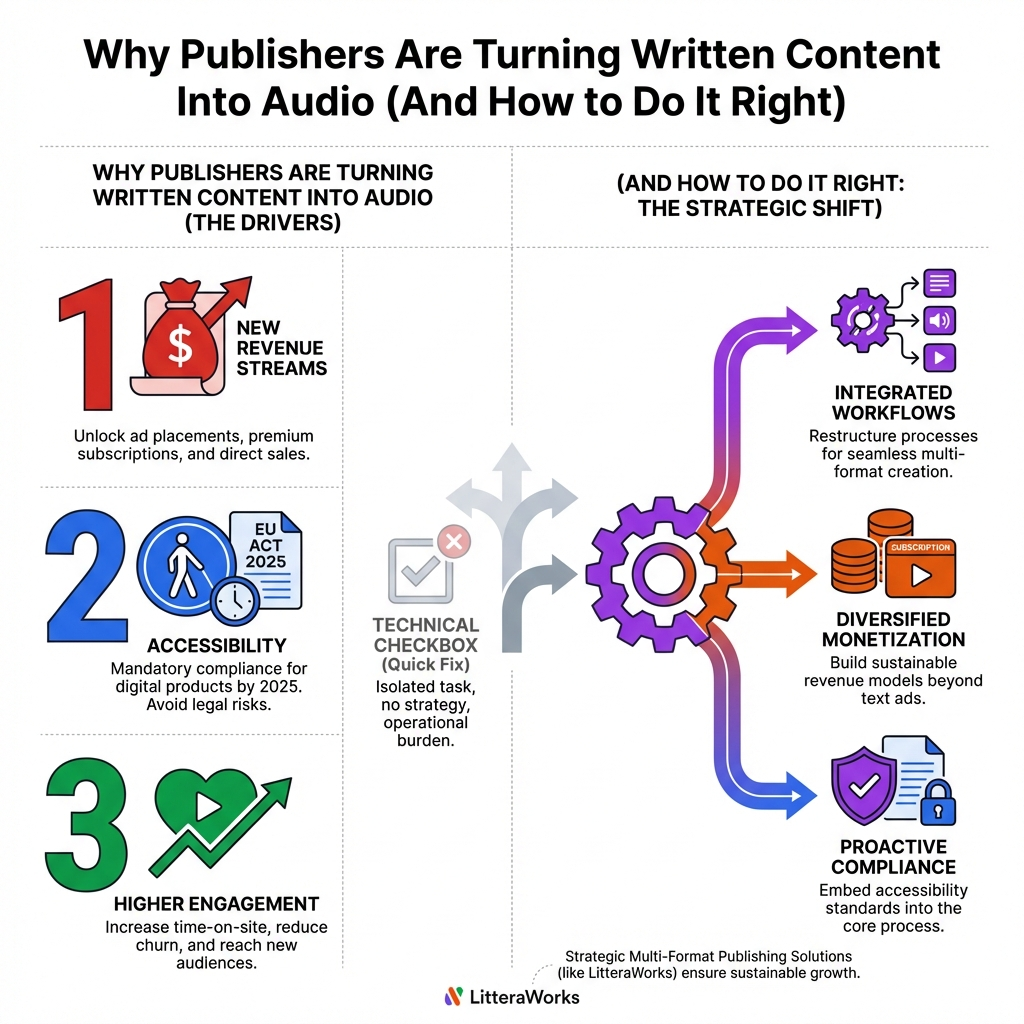
Audio publishing is driven by three converging forces that make it a business imperative, not a nice-to-have feature.
- Revenue diversification comes first. Audio opens new monetization paths through premium subscriptions, sponsorships, and cross-platform distribution. According to Edison Research's 2025 Infinite Dial Report, 74% of Gen Z and Millennial readers prefer listening to long-form articles while multitasking. That's not a niche preference. That's a primary consumption mode for the next generation of news consumers.
- EU accessibility compliance is becoming mandatory, not optional. New WCAG 2.3 guidelines mandate audio alternatives for long-form digital content, and pan-European publishers need to demonstrate compliance across multiple markets. This isn't just about avoiding penalties. It's about demonstrating organizational values and reaching underserved audiences who rely on audio formats.
- Audience engagement metrics tell a clear story. According to the Reuters Institute Digital News Report 2025, audio articles have a 65% completion rate compared to 28% for written text. Digiday Research found that publishers using AI-audio see a 15% lift in newsletter sign-ups from mobile users. When readers can consume content during commutes, workouts, or household tasks, engagement patterns fundamentally shift.
Publishers who move first capture these audience habits before competitors establish dominance. But only if they implement audio strategically.
Why Most Audio Initiatives Fail: The Workflow Problem
The gap between audio ambitions and audio reality usually comes down to workflow integration, or the lack of it.
Point solutions create coordination overhead. When transcription happens in one tool, translation in another, and subtitling in a third, the operational burden negates any efficiency gains from automation. Editorial teams end up managing file transfers, format conversions, and version control across multiple platforms. What should streamline publishing instead creates bottlenecks.
Manual review requirements balloon when AI quality is inconsistent. If transcription accuracy varies unpredictably, editors can't trust batch processing. They're forced to review every output line-by-line, which defeats the purpose of automation. Word-Error-Rates datasets show that quality variance matters more than average quality when teams are deciding whether to trust automated workflows.
Lack of CMS integration means audio publishing becomes a parallel workflow that editorial teams resist. When publishing audio requires leaving the CMS, uploading files to separate platforms, and manually syncing metadata, adoption stalls. The path of least resistance is to skip audio entirely, especially under deadline pressure.
The pattern is consistent: publishers implement audio tools without integrating them into existing editorial processes, then wonder why adoption fails and ROI never materializes.
The EU Compliance Reality: What It Means for Publishers
Accessibility compliance is shifting from voluntary best practice to regulatory requirement. Publishers need solutions with proven track records in EU-funded projects, not experimental platforms still working out compliance details.
Platforms like Litteraworks, which have delivered on Erasmus+ and Creative Europe projects, demonstrate the compliance-ready infrastructure that regulatory environments demand. That track record matters when legal teams are evaluating vendor risk and compliance posture.
Multi-language support isn't optional for pan-European publishers. Compliance means providing accessible formats across all markets you serve. A platform supporting transcription and translation in 40+ languages, like Litteraworks, becomes table stakes rather than a premium feature. Publishers operating in multiple European markets can't afford to patch together language coverage with point solutions.
Compliance isn't just penalty avoidance. It's about reaching audiences who depend on audio formats for content access. Visually impaired readers, users with reading disabilities, and audiences who prefer audio for cognitive accessibility reasons represent significant market segments. Publishers who treat accessibility as a checkbox miss the opportunity to serve these audiences well and build loyalty.
The compliance landscape rewards publishers who partner with platforms that understand EU requirements from direct project experience, not those who bolt on accessibility features as afterthoughts.
How to Implement Audio Strategically: A Framework
Strategic implementation starts with workflow integration, not tool selection.
Choose platforms that connect to existing CMS and editorial processes. If audio publishing requires leaving your content management system, it will never scale. Look for solutions that integrate into the tools your editorial team already uses daily, reducing friction rather than adding steps.
Litteraworks exemplifies this approach by offering multiple transcription methods that fit diverse editorial workflows: a web platform for batch processing, mobile apps (iOS and Android) for field recording, and browser extensions (Chrome and Edge) for quick transcription during research. This flexibility means different team members can use the method that fits their specific workflow, rather than forcing everyone into a single process. We will also give you REST API endpoints and docs, to help you integrate with your processes, or take over and help you integrate audio processes into your workflow.
Prioritize automation that enhances editorial control rather than replacing it. The goal isn't to remove human judgment from publishing. It's to automate repetitive tasks so editors can focus on quality and strategy. Batch processing with human review checkpoints gives teams efficiency without sacrificing standards. Litteraworks is designed around this principle, automating transcription, translation, and automated subtitling (in VTT format) while preserving editorial oversight at critical decision points.
Select proven solutions over experimental AI. Look for platforms trusted by newsrooms and broadcasters across Europe, not startups promising capabilities they haven't delivered at scale. The difference between a platform that's been tested in production environments and one that's still working out reliability issues becomes apparent under deadline pressure.
Implement integrated platforms that combine transcription, translation, automated subtitling, and article generation. This eliminates the coordination overhead of point solutions. When one platform handles the entire workflow from audio input to published article with subtitles, teams avoid the file management, format conversion, and version control problems that sink multi-tool implementations.
For multi-language compliance specifically, platforms supporting 40+ languages for transcription, translation, and subtitles (like Litteraworks) meet the pan-European publisher requirements that regulatory compliance demands. This isn't about feature lists. It's about operational readiness for the compliance environment publishers now operate in.
The Partnership Approach: Why Platform Choice Matters
Audio publishing requires partnership, not just software. The platforms that succeed in editorial environments are those built by teams who understand publishing workflows, not just AI capabilities.
Publishers need platforms that have proven themselves in demanding environments. Newsrooms and broadcasters across Europe trust Litteraworks because it's been tested under deadline pressure, in multi-language contexts, and with the compliance requirements that EU-funded projects demand. That operational track record matters more than feature lists.
The integration approach matters too. Platforms that force workflow changes fail, regardless of technical capabilities. Platforms that adapt to existing editorial processes succeed. This is why Litteraworks' multiple transcription methods (web, mobile, browser extension) represent more than convenience. They represent a design philosophy that prioritizes editorial workflow over technical elegance.
Strategic audio publishing means choosing partners who understand that automation should enhance editorial control, not replace it. The goal is to free editorial teams from repetitive transcription and translation tasks so they can focus on the judgment calls that require human expertise: story selection, editorial standards, and audience strategy.
Moving Forward with Publishers Audio Content Strategy
The publishers succeeding with audio aren't treating it as a technical feature to implement. They're approaching it as a strategic business decision that requires organizational alignment, workflow integration, and proven solutions.
The framework is clear: start with compliance requirements, integrate workflows into existing CMS, prioritize platforms with EU project track records, and measure operational efficiency alongside audience engagement. Publishers who follow this framework capture the revenue opportunities and meet regulatory requirements. Those who treat audio as a bolt-on feature waste resources and frustrate teams.
The difference between these approaches isn't subtle. It's the difference between audio as an operational burden and audio as a strategic capability that expands reach, drives revenue, and demonstrates compliance readiness.
Ready to implement audio publishing strategically? Explore how Litteraworks integrates transcription, translation, and subtitling into your existing workflow, with proven experience from newsrooms and broadcasters across Europe. See the platform in action and discover how workflow-integrated solutions deliver results that point solutions can't match.