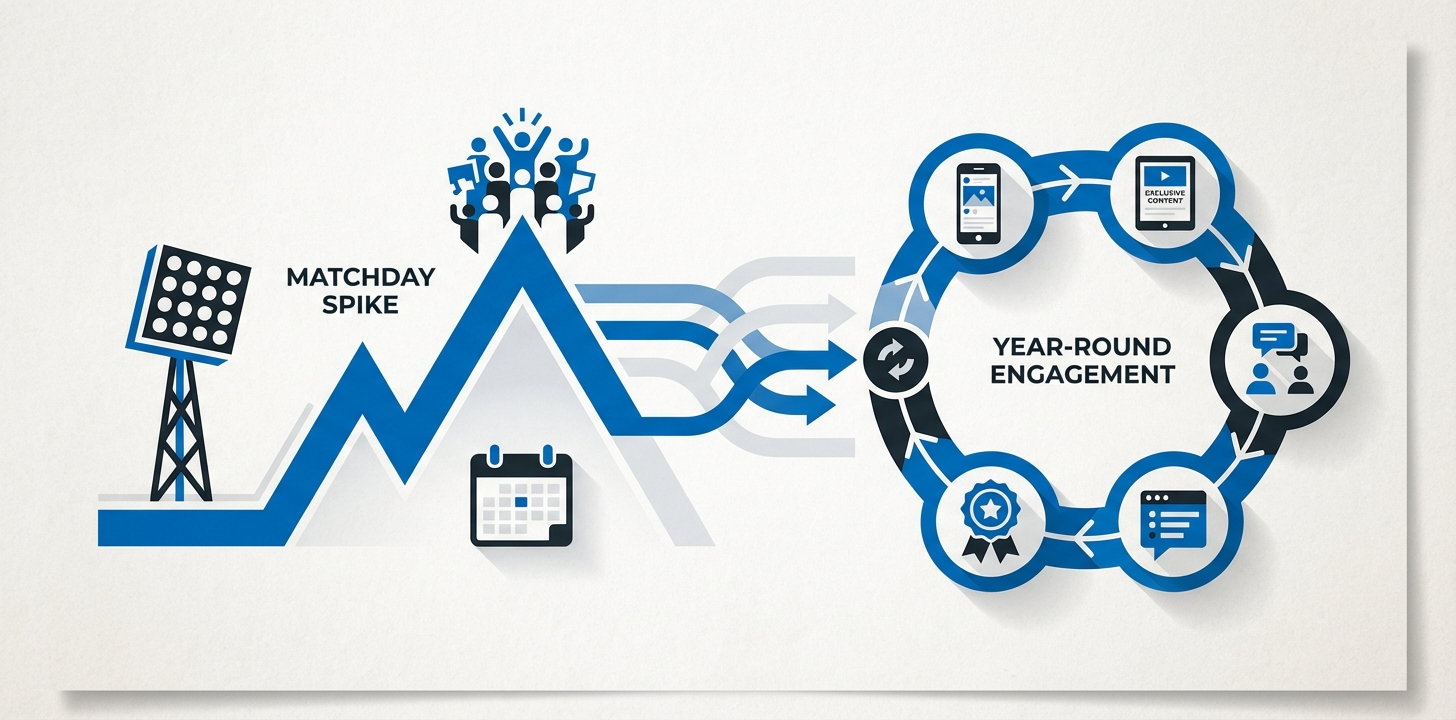
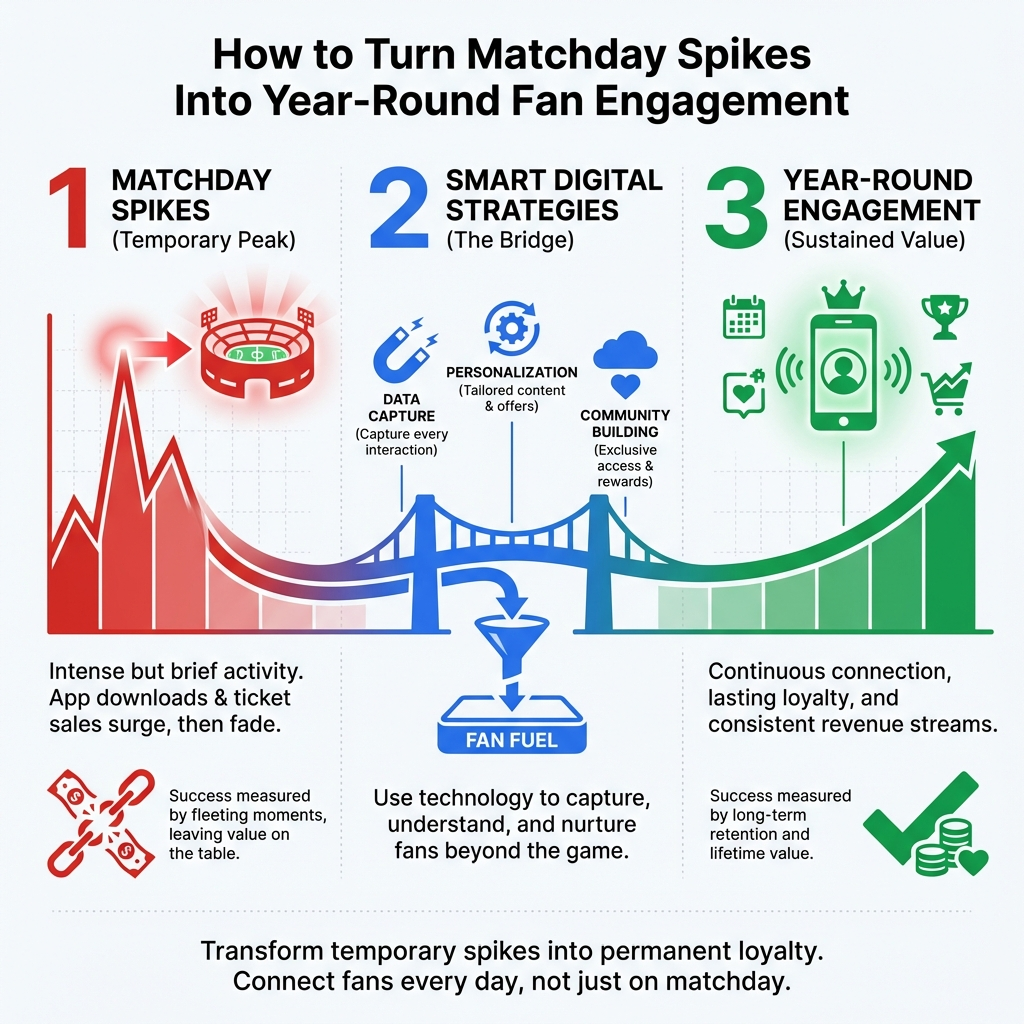
Your biggest matchday success is actually your biggest failure. Those traffic spikes you celebrate - the surge in app downloads, ticket sales, and social media activity - are proof you're leaving money and loyalty on the table. The real question isn't how many fans show up on game day. It's how many stick around when the stadium lights go dark.
Sports organizations measure success by matchday engagement peaks, but this metric masks a critical problem: fans vanish between games, leaving revenue potential and community relationships dormant. According to PwC research, only 19% of younger fans (Gen Z) watch an entire game when tuning in from home. If organizations can't hold attention during the main event, what happens during the weeks of silence between matches?
The answer is predictable. Fans disengage, competitors fill the void, and organizations wonder why their massive matchday investments don't translate into lasting loyalty or year-round fan engagement.
The Matchday Trap: Why Peak Engagement Is a Warning Sign
Matchday spikes indicate fans engage transactionally, not relationally. They show up for the event, not the community. The psychology of loyalty requires consistent touchpoints, not seasonal interactions. When fans only interact with your organization during matches, you're training them to disengage.
Organizations celebrate matchday metrics while ignoring the dramatic drop-off that follows. App downloads surge on game day, then 80% of those users never return. Social media engagement explodes during matches, then flatlines for weeks. This pattern isn't a success story. It's a warning that your organization exists in fans' minds only when there's a game to watch.
The competitive landscape intensifies this problem. During off-season, fans need reasons to choose your organization over Netflix, gaming, social media, and countless other entertainment options. Without a compelling value proposition between games, you're competing for attention with every algorithm-optimized platform designed to capture and hold engagement.
Spikes without sustained engagement build habits of disengagement. Fans learn that your organization is relevant only during matches. They learn to ignore your communications between games. They learn to treat you as a seasonal entertainment option, not a year-round community.
The Real Challenge: Converting Visitors Into Community Members
One-time matchday visitors have no reason to return without a compelling value proposition between games. Generic mobile apps that serve as ticketing platforms miss the behavioral psychology needed to build habits. These apps function as transactional tools - buy a ticket, view a schedule, check scores - without creating reasons for daily or weekly engagement.
The gap isn't technological. Most sports organizations already have mobile apps. The gap is strategic. Generic ticketing platforms weren't designed to solve the year-round engagement problem. They were built to optimize matchday transactions, which is exactly what they do.
This is where purpose-built platforms like FanFuel enter the conversation. FanFuel is a mobile platform specifically designed to address the behavioral psychology gap that generic ticketing apps miss. Instead of treating fans as ticket buyers, FanFuel treats them as community members who need reasons to engage when there's no game on the calendar.
Competition for attention intensifies during off-season. According to IBM survey data, personalized experiences can increase fan retention by up to 40% among younger audiences. But personalization requires infrastructure that most ticketing platforms don't provide. Fans need content, challenges, rewards, and social features that maintain relevance between games.
The strategic question isn't whether to invest in year-round engagement. It's whether to build the infrastructure yourself or partner with platforms designed for this specific challenge.
The Year-Round Engagement Framework: Four Strategic Pillars
Building sustained engagement requires four interconnected pillars that work together to create habits, maintain relevance, and foster community. Each pillar addresses a specific aspect of fan psychology.
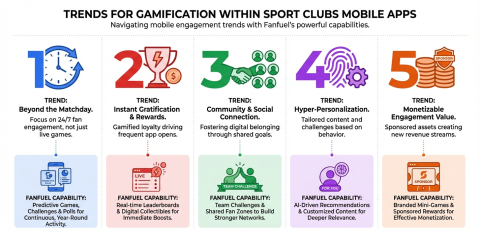
- Gamification mechanics that reward consistent interaction, not just matchday attendance. Points systems, challenges, and progression mechanics create reasons to engage daily or weekly. FanFuel's gamification capabilities include fan challenges, leaderboards, and reward tiers that acknowledge consistent participation. A fan who checks in daily, completes trivia challenges, or participates in prediction games builds a habit loop that persists between matches.
- Personalized content that maintains relevance between games. Behind-the-scenes access, player stories, training updates, and exclusive insights keep fans connected to the narrative when there's no match to watch. FanFuel's personalization engine delivers content based on fan preferences, interaction history, and engagement patterns. A fan who follows specific players receives content about those players. A fan who engages with tactical analysis receives deeper strategic content.
- Community-building features that transform individual fans into a connected group. Forums, fan challenges, and social recognition create belonging beyond the stadium. When fans interact with each other - not just with the organization - they build relationships that persist independent of match schedules. FanFuel's community features enable peer-to-peer interaction, user-generated content, and social dynamics that make the platform valuable even when official content is scarce.
- Exclusive offers and experiences that reward loyalty year-round. Early ticket access, VIP opportunities, merchandise discounts, and tiered benefits acknowledge consistent engagement. These rewards create tangible value for fans who show up between games, reinforcing the habit of regular interaction.
These four pillars work together. Gamification drives frequency, personalized content maintains relevance, community features create peer accountability, and exclusive rewards provide tangible value. Remove any pillar, and the framework weakens.
From Strategy to Implementation: Building a Mobile-First Loyalty Platform
Strategy without execution is just theory. The challenge is translating these four pillars into a platform that fans actually use. Mobile-first design ensures fans can engage anywhere, anytime - not just when they're near the stadium. According to Stats Perform's 2026 Report, 81% of sports media executives expanded their use of AI in 2025 to gain efficiency and cut costs. The technology exists. The question is implementation.
Organizations face a build-versus-partner decision. Building a custom platform from scratch requires engineering resources, ongoing maintenance, and continuous feature development. Most organizations don't have the technical capacity or strategic focus to build and maintain a purpose-built engagement platform while running their core operations.
This is where Appworks functions as a digital transformation partner, not a product vendor. We operate by listening to organizational needs and building our platforms on basis of them. The conversation starts with understanding your specific engagement challenges, fan demographics, and organizational constraints. Only then does the discussion move to how our fan engagement platofrm FanFuel can address your challenges.
FanFuel provides the infrastructure to implement gamification, personalized content, and community features without building from scratch. The platform combines these capabilities in a single mobile-first system, eliminating the need to cobble together multiple tools. One platform handles fan challenges, content delivery, community forums, and reward management. One backend provides the data infrastructure to understand engagement patterns and optimize content strategy.
Success depends on understanding fan psychology and technology equally. Most solutions over-index on one while neglecting the other. Technology vendors pitch feature-heavy platforms without strategic context. Strategy consultants recommend engagement frameworks without technical implementation paths. FanFuel bridges this gap by combining mobile-first infrastructure with strategic consultation around fan psychology and sustained engagement.
The global sports technology market is projected to reach $40.2 billion by the end of 2026, according to industry analysis. But technology spending doesn't equal engagement results. Organizations need partners who understand that the goal isn't implementing technology. The goal is converting matchday spikes into year-round loyalty.
Measuring What Matters: Redefining Success Beyond Matchday
If matchday spikes are the wrong metric, what should organizations measure instead? The answer lies in tracking behaviors that indicate sustained engagement and community membership, not transactional interactions.
Track off-season engagement rates, not just matchday spikes. Weekly active users during periods with no matches reveal whether your strategy is working. If engagement drops to near-zero between games, your platform is still functioning as a matchday tool, not a year-round community hub.
Monitor conversion from one-time visitors to repeat users. This metric reveals whether matchday traffic is becoming long-term engagement. Say a matchday brings 10,000 app users. How many return within seven days? How many are still active 30 days later? How many become weekly users? These conversion rates matter more than the initial spike.
Measure community-building indicators like user-generated content, forum participation, and peer-to-peer interactions. When fans start creating content, responding to each other, and initiating conversations without official prompts, you've built a community. These signals indicate true loyalty because they reflect engagement that persists independent of your organization's content output.
According to Stats Perform research, 70% of sponsors now demand more digital content, but 33% of executives struggle to find authentic ways to deliver it. Year-round engagement platforms solve this problem by creating continuous content opportunities and sponsor integration points that feel natural rather than forced.
The metrics that matter are the ones that predict long-term loyalty and sustained revenue. Matchday spikes predict neither.
The Path Forward: Matchday as Hook, Not Goal
The insight that transforms strategy is simple: matchday is the hook, not the goal. The real value happens between games, when you convert temporary visitors into long-term advocates. That's where revenue and loyalty live.
Organizations that can't sustain engagement between matches will lose fans to competitors who understand that loyalty is built through consistent touchpoints, not seasonal spikes. The competitive advantage goes to organizations that treat matchday as an acquisition opportunity and off-season as the retention battleground.
FanFuel helps sports organizations across 4 continents convert matchday spikes into year-round loyalty through mobile-first platforms designed around fan psychology. The platform combines gamification, personalized content delivery, and community-building features in a single system that addresses the sustained engagement challenge without requiring organizations to build infrastructure from scratch.
Digital transformation in sports isn't about adding more technology. It's about aligning technology with the actual challenge: keeping fans engaged when there's no game to watch. That requires understanding behavioral psychology, mobile engagement patterns, and community dynamics as deeply as you understand matchday operations.
Ready to transform matchday spikes into year-round fan engagement? Discover how FanFuel helps sports organizations build mobile-first engagement strategies that convert casual fans into community members. The conversation starts with understanding your specific engagement challenges and organizational context. Reach out to explore whether FanFuel's infrastructure aligns with your strategic needs.